Monday, March 28, 2011

KONARAK SUN TEMPLE

Konarak

c. 1258
Orissa, near Puri

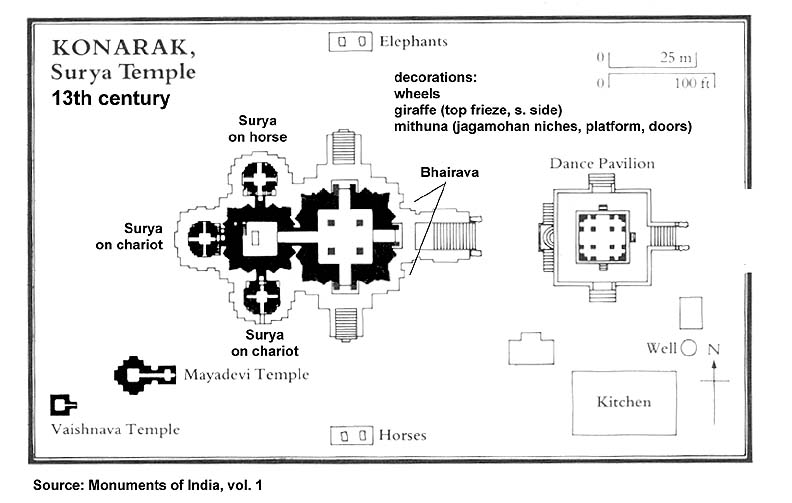
The astonishing Surya temple at Konarak (sometimes spelled "Konark") was built by King Narasimha I (1238-1264) of the Eastern Ganga dynasty as an offering, it is said, to commemorate the king's military victories, greatness, and piety. Konarak had long been a center of sun worship, which is rare in other parts of India. Even in its present ruinous and eroded state (rear of sanctuary, photo) the temple exudes grandeur in its size, its design concept, and in the detail and excellence of its carving. Its enormous sanctuary tower collapsed in the 19th century; the large pyramidal roof in the photo (38.4m, or 126ft) covers only the temple's jagamohan, or entrance hall. The sanctuary tower was about twice as tall.
The temple faces east (plan). It was conceived as the chariot of the sun god, Surya, carried upon twelve pairs of wheels representing the months, and drawn by seven horses representing the days of the week (following pages). The idea of a temple as the chariot of its god is not unique to Konarak, although this is certainly the most splendid instance; see the glossary entry about rathas for additional examples.
Seen from the east in this photo are the remains of a columned dance hall in front of the jagamohan. The dance hall is elevated upon a tall platform, and fronted by curious oversize images of rampant lion

AMARNATH TEMPLE

Location: 145-km From Srinagar, Kashmir
Region Altitude: 4,175m (13,700ft).
Darshan Season: July To August

Amarnath is 145 km east of Srinagar in Kashmir. There is an ice Silva-linga here that changes size with the seasons, and also as the moon waxes and wanes it becomes bigger and smaller. On the full moon day the linga is about 6 ft high. Each year on the full moon day of July-August (Sravana) when the Siva-linga attains its maximum height there is a festival at this cave temple. It is said that Lord Siva first appeared on this day.

Amarnath Cave Temple It is located in a glacial valley at 4,175m (13,700 ft.). The cave is about 150 feet high and 90 feet long. Within the cave there are four or five ice formations that resemble the figures of different gods. The biggest figures of different gods. The biggest figure is regarded as Siva (Amarnath). On the left side of the linga is an ice formation called Ganesh, and on the right side is one of Parvati and Bhairava.

The area is covered with snow from September to June. The cave opens only in July and August. This is the rainy season, so pilgrims have to brave the rain to get there. About 25,000 people make this pilgrimage each year. You can also hire ponies and dandies for the trip. It is very crowded during the annual Sravana festival. There is a yearly pilgrimage starting from Srinagar that is led by the Chhari Saheb, the holy seepter.

Amarnath Yatra
The of the most important event during July/ August, is Amarnath Yatra to the Holy Pilgrimage. This is an annual event when thousands of Hindus from different corners of the Globe visit Amarnath caves. The pilgrims trek from Pahalgam to these caves and worship the great ice Lingam. Legend has it that Shiva recounted to Parvati the secret of creation in a cave in Amarnath. Unknow to them, a pair of mating doves eavesdropped on this conversation and having learned the secret, are reborn again and again, and have made the cave their eternal abode. Many pilgrims report seeing the doves-pair when they trek the arduous route to pay obeisance before the ice-lingam (the phallic symbol of Shiva). This is an event you certainly will talk about for the rest of your life.

The Legend
There is famous Rigvedic Verse that says "Ekam Sat " that is "There is one Being ,the sages call Him by many names." The God (Parmeshwar) has three deities who carry on the world .This is Known as Holy Trinity. Brahma- the creator, Vishnu - the perpetuator of life and Shiva (Mahesh ) -the purifier and perpetuator of good and destroyer of evil. Rig Veda refer Shiva as Rudra as in its following verse . "We Worship Tryambaka (Rudra) , Who spread Fragrance and Increases Nourishment , May He release me ,like the cucumber from its stem , From Mortal Life , But not From Immorality . "(Rig Veda Mandal VII Sukta 59 and Mantra 12)

The Yajurveda describes Shiva as ascetic warrior Whose robe is of Deer Skin and He carries Trishul .

According to the verse Satyam, Shivam ,Sundaram ,the life is described as having three facets Truth (Satyam), Good (Shivam) and the Beautiful (Sundaram). Shiva is a living God. The most Sacred and ancient books of India, the Rig Veda narrates His presence in the hymns. Vedic myths, rituals and even astronomy testifies to His existence from the dawn of time .The Mohindaro and Harapa findings confirm Shiva worship in the ancient India. According to the older scriptures, He has three places of His residence. One is Kailash Parvat another is Lohit Giri under which Brahamputra flows and third is Muzwan Parvat .
Significence of Amarnath Cave
Raghunath temple, UdhampurThe Legend about the importance of Amarnath Cave is as follows :
  • This is The Cave which was chosen by Bhole Shankar for narrating the secrets of immortality and creation of Universe to Maa Parvati ji . The story goes like this . Centuries ago Maa Parvati asked Shiv ji to let her know why and when He started wearing the beads of heads ( Mund Mala) . Bhole Shankar replied when ever you are born I add one more head in my beads . Maa Parvati said ," My Lord, my body is destroyed every time and I die again and again, but you are Immortal. Please let me know the secret of this ." Bhole Shankar replied that it is due to Amar Katha ."
  • Maa Parvati insisted that she may be told that secret. For long Shiva ji continued postponing . Finally on consistent demand from Maa Parvati He made up his mind to tell the immortal secret . He started for lonely place where no living being could listen it . He choose Amarnath Cave . In preparation to that He left His Nandi ( The Bull which He used to ride ) at Pahalgam (Bail gaon) . At Chandanwari He released Moon from his hairs (Jataon). At the banks of Lake Sheshnag He released the snakes . He decided to leave his Son Ganesha at Mahagunas Parvat (Mahaganesh Hill ) . At Panjtarni, Shivji left the Five Elements behind (Earth , Water, Air , Fire and Sky) which make living being . He is the Lord of these elements. It is believed that as a symbol of sacrificing the earthly world , Shivaji and Maa Parvati had Tandav Dance . After leaving behind all these, Bhole Shankar enters the Holy Amarnath Cave along with Parvati Maa.
  • Lord Shiva takes his Samadhi on the Deer Skin and concentrate . To ensure that no living being is able to hear the Immortal Tale , He created Rudra named Kalagni and ordered him to spread fire to eliminate every living thing in and around the Holy Cave . After this He started narrating the secret of immortality to Maa Parvati . But as a matter of chance one egg which was lying beneath the Deer skin remained protected . It is believed to be non living and more over it was protected by Shiva -Parvati Asan (Bed) . The pair of pigeons which were born out of this egg became immortal having listened the secret of immortality (Amar Katha). Many pilgrims report seeing the pair of pigeons when they trek the arduous route to pay their obeisance before the Ice-Lingam (the phallic symbol of Shiva).

MEENAKSHI TEMPLE

Location : Madurai
Famous For : World Renowed Meenakashi Temples
Dedicated to : Lord Shiva and Meenakashi
Related Links: Madurai


No text can do justice to the Meenakshi temple. The gigantic temple complex, the statues exploring the entire range of human emotions, everything here is larger than life. The Meenakshi temple complex is a city temple - one of the largest and certainly one of the most ancient. According to legend Madurai is the actual site where the wedding between Shiva and Meenakshi took place. The soaring and exquisitely carved towers enclose the temple dedicated to Meenakashi. The south gateway contains the twin temples of Shiva and Meenakshi and is about nine storeys high.

Meenakshi TempleThe Origin Of The Meenakshi Temple
The Sri Meenakshi Sundareswara temple and Madurai city originated together. According to tradition, Indra once committed sin when he killed a demon, who was then performing penance. He could find no relief from remorse in his own kingdom. He came down to earth. While passing through a forest of Kadamba trees in Pandya land, he felt relieved of his burden. His servitors told him that there was a Shivalinga under a Kadamba tree and beside a lake. Certain that it was the Linga that had helped him; he worshipped it and built a small temple around it. It is believed that it is this Linga, which is till under worship in the Madurai temple. The shrine is called the "Indra Vimana".

Once Dhananjaya, a merchant of Manavur, where the Pandyas had arrived after the second deluge in Kumari Kandam, having been overtaken by nightfall in Kadamba forest, spent the night in the Indra Vimana. When next morning he woke up, he was surprised to see signs of worship. Thinking that it must be the work of the Devas, he told the Pandya, Kulasekhara, in Manavur, of this. Meanwhile Lord Shiva had instructed Pandya in a dream to build a temple and a city at the spot Dhananjaya would indicate. Kulasekhara did so. Thus originated the temple and city.

Earliest References Of The Temple
Paranjothi Munivar wrote the Tiruviayadal Puranam in the sixteenth century. It is regarded as the temple's Sthalapurana. An earlier work adds a few celestial sports not included in the latter. These are, or rather were painted on the walls around the Golden Lily Tank. Some of the painted wooden panels are in the Temple Museum.

The earliest references available to any structure in this temple is a hymn of Sambhandar's, in the seventh century, which refers to the "Kapali Madil". The present inner walls of th
Location : Madurai
Famous For : World Renowed Meenakashi Temples
Dedicated to : Lord Shiva and Meenakashi
Related Links: Madurai


No text can do justice to the Meenakshi temple. The gigantic temple complex, the statues exploring the entire range of human emotions, everything here is larger than life. The Meenakshi temple complex is a city temple - one of the largest and certainly one of the most ancient. According to legend Madurai is the actual site where the wedding between Shiva and Meenakshi took place. The soaring and exquisitely carved towers enclose the temple dedicated to Meenakashi. The south gateway contains the twin temples of Shiva and Meenakshi and is about nine storeys high.

Meenakshi TempleThe Origin Of The Meenakshi Temple
The Sri Meenakshi Sundareswara temple and Madurai city originated together. According to tradition, Indra once committed sin when he killed a demon, who was then performing penance. He could find no relief from remorse in his own kingdom. He came down to earth. While passing through a forest of Kadamba trees in Pandya land, he felt relieved of his burden. His servitors told him that there was a Shivalinga under a Kadamba tree and beside a lake. Certain that it was the Linga that had helped him; he worshipped it and built a small temple around it. It is believed that it is this Linga, which is till under worship in the Madurai temple. The shrine is called the "Indra Vimana".

Once Dhananjaya, a merchant of Manavur, where the Pandyas had arrived after the second deluge in Kumari Kandam, having been overtaken by nightfall in Kadamba forest, spent the night in the Indra Vimana. When next morning he woke up, he was surprised to see signs of worship. Thinking that it must be the work of the Devas, he told the Pandya, Kulasekhara, in Manavur, of this. Meanwhile Lord Shiva had instructed Pandya in a dream to build a temple and a city at the spot Dhananjaya would indicate. Kulasekhara did so. Thus originated the temple and city.

Earliest References Of The Temple
Paranjothi Munivar wrote the Tiruviayadal Puranam in the sixteenth century. It is regarded as the temple's Sthalapurana. An earlier work adds a few celestial sports not included in the latter. These are, or rather were painted on the walls around the Golden Lily Tank. Some of the painted wooden panels are in the Temple Museum.

The earliest references available to any structure in this temple is a hymn of Sambhandar's, in the seventh century, which refers to the "Kapali Madil". The present inner walls of the Lords shrine bear this name today. In the early times the entire temple must have been confined to the area between these walls, and the structures must have been of brick and mortar.

In the 14th century an invasion by Malik Kafur damaged the temple. In the same century Madurai was under Muslim rule for nearly fifty years. The temple authorities closed the sanctum, covered up the Linga, and set up another in the Ardhamandapa. When the city was liberated, the sanctum was opened, and, tradition says the flower garlands and the sandalwood paste placed on the Linga were as fresh as on the first day, and two oil lamps were still burning. e Lords shrine bear this name today. In the early times the entire temple must have been confined to the area between these walls, and the structures must have been of brick and mortar.

In the 14th century an invasion by Malik Kafur damaged the temple. In the same century Madurai was under Muslim rule for nearly fifty years. The temple authorities closed the sanctum, covered up the Linga, and set up another in the Ardhamandapa. When the city was liberated, the sanctum was opened, and, tradition says the flower garlands and the sandalwood paste placed on the Linga were as fresh as on the first day, and two oil lamps were still burning.

KASHI VISHWANATH TEMPLE

Location: Varansi
Deity: Lord Shiva & Goddess Parvati
Related Links: Varanasi

The oldest living city in the world, Varanasi is the ultimate destination of all Hindu pilgrims searching for moksha from the cycle of birth and re-birth. The word 'Kashi' originated from the word 'Kas' which means to shine. Kashi is mentioned repeatedly in the scriptures - the Brahmanas, Upanishads and the Puranas. It is the oldest center of learning and the University here is still widely respected for its Sanskrit, Philosophy, and Arts faculties. Hyuen Tsang, the Chinese traveler visited Varanasi in the 7th century.

Stepped in tradition and mythological legacy, Kashi is the 'original ground' created by Lord Shiva and Parvati. The Kashi Vishwanath Temple is dedicated to Lord Shiva. The temple was destroyed in the various invasions and was rebuilt in 1776 by Rani Ahilyabai of Indore. Hundreds and thousands of pilgrims flock to Varanasi to offer homage and wash away their sins.

Vishweshwara jyotirlinga has a very special and unique significance in the spiritual history of India. Deeply and intimately implanted in the Hindu mind, the Kashi Vishwanath Temple has been a living embodiment of our timeless cultural traditions and highest spiritual values. The Temple has been visited by all great saints- Adi Shankaracharya, Ramkrishna Paramhansa, Swami Vivekanand, Goswami Tulsidas, Maharshi Dayanand Saraswati, Gurunanak and several other spiritual personalities.

MUKTESWARA TEMPLE

Location : Orissa
Significance : Capital of Orissa
Related Links : Lingaraja Temple, Bhubaneswar


Mukteswara Temple Built in the year of AD 950, Mukteswara temple is dedicated to Lord Shiva, and is carved with figures of ascetics in several poses of meditation. The highlight of the temple, is the magnificent torana - the decorative gateway, an arched masterpiece, reminiscent of Buddhist influence in Orissa.

This temple is considered to be the gem of Orissan architecture. The sculptured gateway, the Jagamohana with diamond shaped latticed windows and decorated interiors and the plethora of sculptural work all deserve mention in this temple dedicated to Shiva Although it is only a small monument rising to a height of 35 feet. Literally every inch of its surface is carved. This temple has also been described as a dream realized in sandstone and it is a monument where it is said sculpture and architecture are in complete harmony with one another. This temple dates back to the 10th century.

Architectural Wonder
The sculptural decoration of the Mukteswara is exquisitely executed. The beautiful sculptures eloquently speak of the sense of proportion and perspective of the sculptor and their unique ability in the exact depiction of the minutest objects. The builders of Mukteswara Temple introduced new architectural designs, new art motifs and new conceptions about the icnography of the cult images. There are a number of depictions of skeletal ascetics among the sculptural images, most of them shown in teaching or meditation poses, which seems appropriate as the name Mukteswara means "Lord who gives freedom through Yoga".

THANJAVUR TEMPLE

Area 29.24 sq. kms.
Population 2,00,216 ( 1991 census )
Season Throughout the year
Languages spoken Tamil, English and Marathi


Thanjavur was the royal city of the Cholas, Nayaks and the Mahrattas. Thanjavur derives its name from Tanjan-an asura (giant), who according to local legend devastated the neighbourhood and was killed by Sri Anandavalli Amman and Vishnu, Sri Neelamegapperumal. Tanjan's last request that the city might be named after him was granted.

Thanjavur TempleThanjavur rose to glory during the later Chola reign between the 10th and the 14th Centuries and became a centre of learning and culture. It is the headquarters of the disrict of the same name. Thanjavur district, the ' Rice Bowl ' of Tamil Nadu, is also known for its exquisite handicrafts, bronzes and South Indian Musical Instruments.

History
A brief introduction to the Later Cholas or the Thanjavur Cholas. Rajaraja Cholan the Great, occupies the foremost place in the history of the later Cholas. Vijayalaya Chola was the founder of the later Chola dynasty. He conquered the country from a vassal chief of the pallavas, and established Thanjavur as the capital of the dynasty. His son and successor Aditya I conquered the pallavas and the Kongu country; and his son Parantakan I (AD 907-953), under his leadership, the cholas acquired a dominion which foreshadowed the greater empire Rajarajan and Kulotungan.
Pilgrimage Attraction of Thanjavur
  • Bragatheeswarar Temple
    Bragatheeswarar Temple, ThanjavurThe Big Temple. Rajaraja Cholan, the Great Chola king built Bragatheeswarar Temple. Big Temple is an example for the Indian sculptural architecture greatness. Temple is surrounded by moat on two sides and Grand Anaicut river on the other side. This temple is unique to have the tallest tower over the sanctum sanctorum unlike the other temples. It is 216 feet tall. The stupa at the top is made of bronze.The walls of the sanctum are covered, with the wall paintings of Chola and Nayak periods, comparable to the famous Ajanta cave frescoes.

    Guarding the inner shrine of the temple, is the gigantic statue of Nandi, the Bull. The Nandi is 12 feet tall, 191/2 feet long and 81/4 feet wide. And it weighs around 25 tons. Nayaka kings constructed a Mandapam for the Nandi to protect it from sun and rain.
  • Puliyur Vyagrapureeswarar Temple
    Around 80 Kms from Thanjavur, situated 3/4 Km North of Ramarmadam Busstop in Nagapattinam - Tiruvarur Main Road. The ancient history says Kamadhenu, the devalogha cow prayed to Lord shiva in this shrine to get rid of its sabam. One more speciality about this temple, on evenings, Nataraja is worshipped first prior to all other gods. This is also referred as Dhakshina Chidambaram. chidambaram is where famous temple of lord Nataraja located. This village is also called as Vyagrapuri named after the lord.
  • Sikkal Singaravelavar Temple
    Around 80 Kms from Thanjavur situated in Nagapattinam Tiruvarur Main Road. The ancient history says here only Lord Murugan got the 'Sakthi Vel' from Parvathi (refered as Velnedunkanni amman in this temple ) and killed Suran. This temple is one of the few temples in Tamilnadu which has both Siva and Vishnu in the same campus. The 'Vel vankuthal' festival in the Tamil month of Iyappasi is very famous here.
    • Sirkazhi
      Goddess Parvathi gave Gnana milk to Thirugnana Sambandar here, when he was a child. After this, he sang the famous Devaram. Lord Shiva as Thoniappar resides in a thoni (boat). The boat symbolizes that Thoniappar helps people cross their sea of birth. Every year during Thiruvadirai Nakshatra of Chiithirai month, the famous Thirumulaippal Utsav is held.
  • Swamimalai
    Located 32 Kms away, Swamimalai is one of the six abodes (Arupadaiveedu) dedicated to Lord Murugan. Lord Murugan preached Pranava mantra "OM" to Lord Shiva and that why he is called Swaminathan. The 60 steps to the temple indicate the 60 years of the Tamil calendar. This temple is praised by Arunagirinadar. Every Thursday, Lord Swaminathan is decorated with Diamond Vel.
  • Thirubuvanam
    45 Kms away, Thirubuvanam has a 13th century Chola temple dedicated to Lord Shiva. Also well known for its silk weaving industry.
  • Thiruvaiyaru
    13 Kms from Thanjavur, where the famous saint Thyagaraja lived and attained samadhi. The famous temple at Thiruvaiyaru is dedicated to Shiva, and is known as Panchanatheswara. An eight day music festival is held here, every January, in honour of the saint.
  • Thiruvarur
    55 Kms away from Thanjavur. The Thyagarajaswami Temple is famous for the largest temple chariot in Tamil Nadu. This vast temple houses Thyagaraja, Kamalamba and Vanmikanathar and has been sung by the Saiva Saints. The pillars and the halls here are of great beauty. Rajaraja Cholan was an ardent devotee of Thyagarajaswami. This temple is also referred to as a Prithvi (Earth) Sthalam. Thiruvarur is also the birth place of saint Thyagaraja.
  • Vaitheeswaran Kovil
    Vaitheeswaran, Thaiyal Nayaki, Muthukumaraswamy (Shiva, Parvathi, Subramanya Swamy) An ancient temple dedicated to Shiva - as Vaitheeswaran literally meaning the divine provider of cures. Adorned with imposing towers, Mandapams and pillars, this well visited shrine has been sung by the Saivite Saint Poets. It is of said that Angarakan - Mars, Kartikeya, Jatayu and the Rig Veda worshipped Shiva here. This shrine is also referred to as an Angarakasthalam.

SHANKARACHARYA TEMPLE

Kashmir has produced a galaxy of great saints, seers and savants who have enriched, elevated and refined life and helped the people at large in distress. This is perfectly showcased in the Shankracharya Temple. The temple shows the early Kashmiri style. It tries to introduce the early Sihara style and has still one-storeyed gable pediment which is evident even now. Here we find the early specimen of the horse shoe arch, prominent in the final stages of this architecture, as, for example, in Martand.

History
It was first built by Jalauka, the son of great Emperor Ashoka, about 200 B.C. The temple was later rebuilt and dedicated to Jyesthesvara by Gopaditya, who ruled from 253 A.D. to 328. The hill was called Gopadri and the village at its foot on the south is still called Gopkar. It is also said that once Shankaracharya, a famous Hindu saint, came to Kashmir from South India to revive Hinduism. He stayed on the top of the hill for sometime and the hill thus came to be known as Shankaracharya hill.

Architecture & Design
This temple stands on a solid rock and consists of an octagonal basement of 13 layers. Each of the four sides has two projections which terminate in pediment and agable, the latter intersecting the main roof half way up its slope. The body of the temple is surrounded by a terrace enclosed by a stone wall or parapet, 3.5 feet high. This in following the outline of the basement, preserves its octagonal shape. From the terrace another flight often steps leads to the door of the temple. The interior is a chamber, circular in plan, with a basin containing a lingam. The whole of the building is of stone, which is laid throughout in horizontal courses, no cement appearing to have been used.